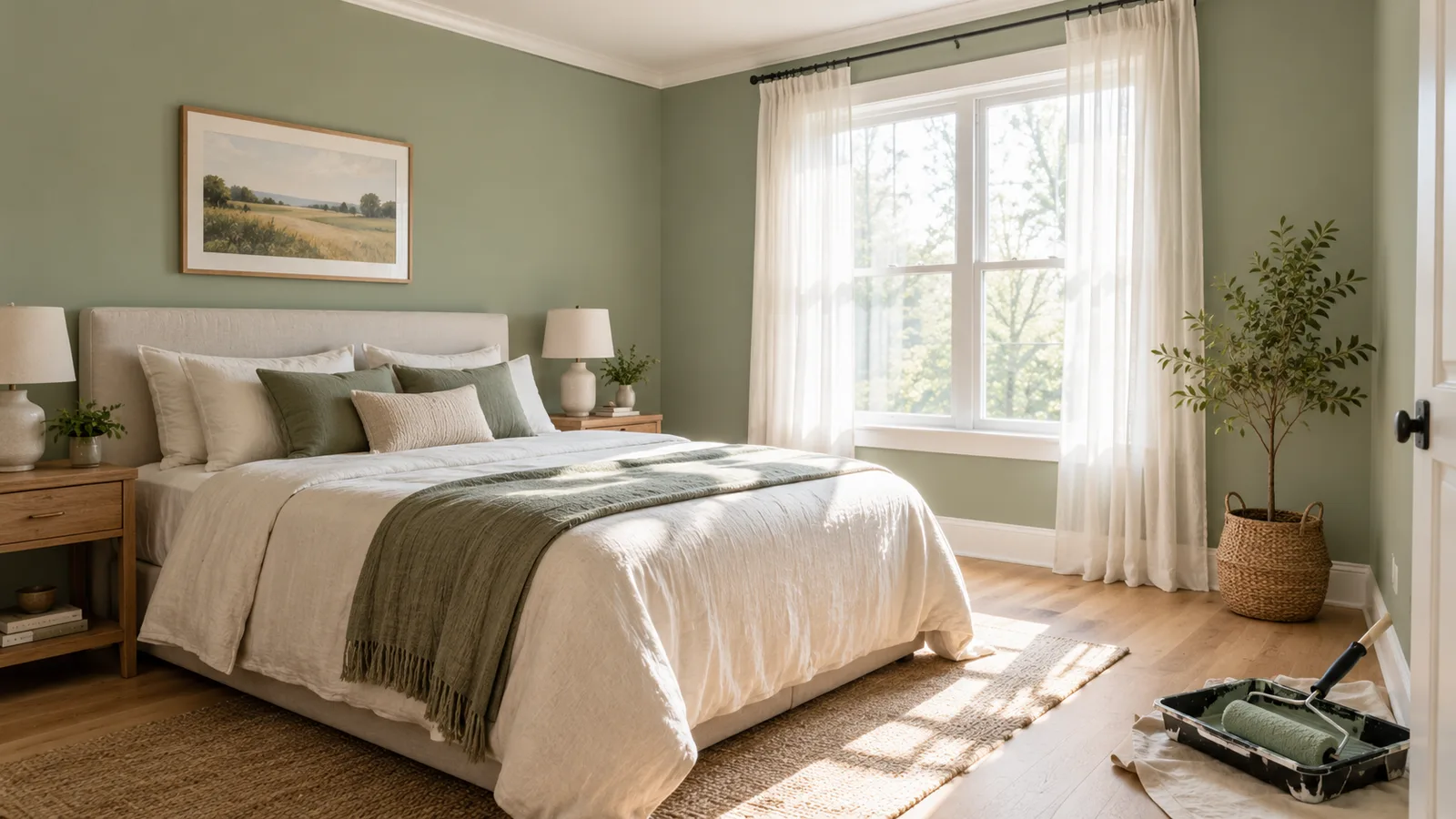
Short answer: A standard 12x12 room with 8-foot ceilings, one door, and two windows needs about 2 to 2.5 gallons of paint for two coats on the walls. Add 1 gallon if you're also painting the ceiling.
That's the number most people need. If your room is a little different, like taller ceilings, more windows, or just one coat, the details below will get you an exact figure so you don't make a second trip to the store.
Skip the math: get your exact number in 30 seconds
Calculate how much paint you need for any room. Get accurate estimates for walls and ceilings.
The Math Behind a 12x12 Room
Paint is bought by the gallon, but it's used by the square foot. So the first step is to work out how much wall you actually have.
Step 1: Find the total wall area
Add up the length of all four walls (the perimeter), then multiply by the ceiling height:
- Perimeter: 12 + 12 + 12 + 12 = 48 feet
- Wall area: 48 ft × 8 ft = 384 sq ft
Step 2: Subtract doors and windows
You won't paint over openings, so take them out. Standard estimates are about 20 sq ft per door and 15 sq ft per window.
- 1 door: 20 sq ft
- 2 windows: 30 sq ft
- Paintable wall area: 384 − 50 = 334 sq ft
Step 3: Multiply by the number of coats
Almost every job needs two coats for even color and a durable finish.
- 334 sq ft × 2 coats = 668 sq ft
Step 4: Divide by coverage and add a buffer
One gallon of interior paint covers roughly 350 sq ft on smooth, primed drywall. Add about 10% for roller absorption, touch-ups, and spills.
- 668 × 1.10 ÷ 350 = 2.1 gallons
In practice, that means two gallons plus one quart. If you plan to keep paint on hand for touch-ups, a third gallon is a reasonable buy.
Buying a 2-gallon project? Ask the store to "box" (mix) both gallons together in a larger bucket. Small color differences between cans disappear, and you won't see a line where one can ended and the next began.
Quick Reference: Paint for Common Room Sizes
All numbers below assume 8-foot ceilings, one door, two windows, two coats, and a 10% buffer, rounded up to the nearest half gallon (the same method our calculator uses).
| Room size | Paintable wall area | Paint for walls (2 coats) |
|---|---|---|
| 10 × 10 | 270 sq ft | 2 gallons |
| 12 × 12 | 334 sq ft | 2.5 gallons |
| 12 × 14 | 366 sq ft | 2.5 gallons |
| 14 × 16 | 430 sq ft | 3 gallons |
| 16 × 20 | 526 sq ft | 3.5 gallons |
What If My Ceilings Are Taller?
Ceiling height has a bigger effect than most people expect, because it multiplies against the entire perimeter.
| 12x12 room with... | Paintable area | Paint for walls (2 coats) |
|---|---|---|
| 8-ft ceilings | 334 sq ft | 2.5 gallons |
| 9-ft ceilings | 382 sq ft | 2.5 gallons |
| 10-ft ceilings | 430 sq ft | 3 gallons |
For vaulted ceilings, use the average height. A room that slopes from 8 to 12 feet is close enough to a 10-foot room for estimating.
Painting the Ceiling Too?
The ceiling of a 12x12 room is simply 12 × 12 = 144 sq ft. Two coats plus the 10% buffer works out to just under one gallon, so buy one gallon of flat ceiling paint.
Ceiling paint is formulated to be extra flat (to hide imperfections) and thicker (to reduce drips), so it's worth using instead of leftover wall paint.
What About Trim, Doors, and Baseboards?
Trim uses surprisingly little paint. For a 12x12 room's baseboards, door casing, and window trim, one quart of semi-gloss is usually plenty for two coats. If you're also painting the door itself (both sides), step up to a half gallon.
Can I Get Away With One Coat?
Sometimes. One coat on a 12x12 room's walls works out to just over 1 gallon (buy a gallon plus a quart), but it only works well when:
- You're using a paint-and-primer product,
- The new color is similar to the old one, and
- The walls are already in good shape (no patches or stains).
Going from a dark color to a light one (or covering fresh drywall patches) almost always needs a primer coat plus two finish coats. Patched spots that skip primer will "flash," showing up as dull patches once the paint dries.
Bare drywall soaks up paint like a sponge. On new drywall, prime first. Your finish paint will go much further and look more even.
Things That Make You Need More Paint
Your real-world number can climb above the estimate if:
- The walls are textured. Orange peel or knockdown texture can cut coverage to 250–300 sq ft per gallon.
- You're making a big color change. Deep reds, navy, and other saturated colors often need a tinted primer and an extra coat.
- You're using a cheap roller. Thin, low-quality covers spread paint unevenly and leave thin spots that need another pass.
- The room has built-ins or an accent wall. Accent walls in a second color need their own quart or gallon.
Tools That Make the Job Easier
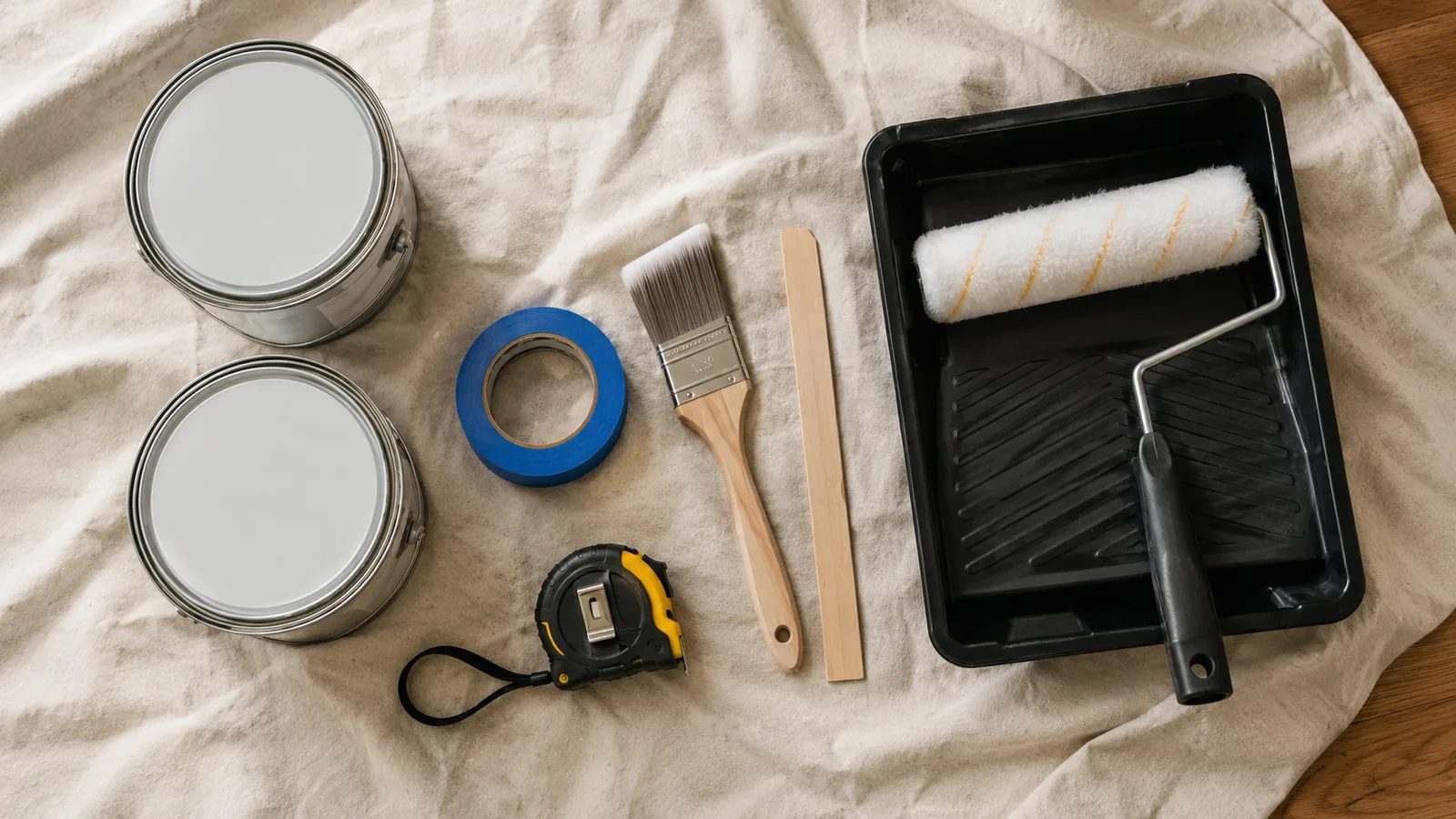
A good roller and an angled brush matter almost as much as the paint itself. These are popular picks for a room this size:
BEHR
BEHR Premium Plus Interior Paint & Primer
- ✓Paint and primer in one
- ✓Low odor
- ✓Good one-coat hide on similar colors
Wooster
Wooster 9-Inch Roller Frame & Cover Kit
- ✓Holds more paint per dip
- ✓Smooth, even finish
- ✓Reusable frame
Purdy
Purdy 2-1/2 Inch Angled Sash Brush
- ✓Clean cut-in lines
- ✓Holds its shape
- ✓Great for trim and corners
3M
ScotchBlue Original Painter's Tape
- ✓Removes cleanly
- ✓Sharp paint lines
- ✓Safe on most surfaces
As an Amazon Associate, we earn from qualifying purchases.
The Bottom Line
For a typical 12x12 room with 8-foot ceilings:
- Walls (2 coats): 2 to 2.5 gallons
- Ceiling (2 coats): 1 gallon
- Trim: 1 quart
If your room has different ceiling heights, more windows, or you want a precise cost estimate, plug your measurements into our free paint calculator. It handles the subtraction, coats, and buffer for you.