How to Organize a Small Kitchen With Zero Extra Storage
If you’ve already maxed out every cabinet and drawer in your kitchen and still can’t find a home for your olive oil, your stand mixer, or that one pan you use every single day, you’re not alone — and you’re not out of options. Learning how to organize a small kitchen when traditional storage has run out is less about buying more stuff and more about rethinking the space you already have. This guide walks you through every overlooked inch of your kitchen, from ceiling height to the backs of your cabinet doors, so you can finally breathe again.
Key Takeaways
- Vertical wall space above cabinets and between shelves is almost always underutilized — and it’s free real estate.
- The backs of cabinet doors and pantry doors can hold a surprising amount of daily-use items with simple, inexpensive organizers.
- Multi-use furniture like rolling carts, kitchen islands with storage, and fold-down tables can dramatically expand your functional space.
- Decluttering duplicates and rarely-used items is the single most effective first step before any organizing system can work.
- Smart container choices — stackable, clear, and uniform — can double the storage capacity of your existing cabinets and shelves.
Start With a Ruthless Declutter
Before you spend a single dollar on organizers or hooks, you need to face a hard truth: most small kitchens aren’t actually out of storage — they’re overfull of things that don’t belong there or simply aren’t used. A thorough declutter is the foundation that makes every other strategy in this guide work dramatically better.
Pull everything out of your cabinets and drawers, one section at a time. Sort items into three piles: keep, relocate, and remove. Be honest. That pasta maker you used once in 2019? That’s a relocate or remove. Five spatulas when you only use two? That’s a remove. Appliances that live on your counter but get used less than once a month can likely be stored in a closet or under-bed storage bin and rotated in seasonally.
Pro tip: The “one in, one out” rule is your new kitchen law. Every time something new enters the kitchen — a new mug, a new gadget — something old has to leave. This single habit prevents the creep of clutter better than any organizer ever could.
Once you’ve pared down to only what you genuinely use and love, you’ll likely discover you have more breathing room than you thought. Now you’re ready to organize strategically.
Go Vertical: The Walls Are Your Best Friend
When floor space is limited, the answer is always up. Vertical storage is one of the most transformative things you can do when you’re figuring out how to organize a small kitchen, and most homeowners dramatically underuse it.
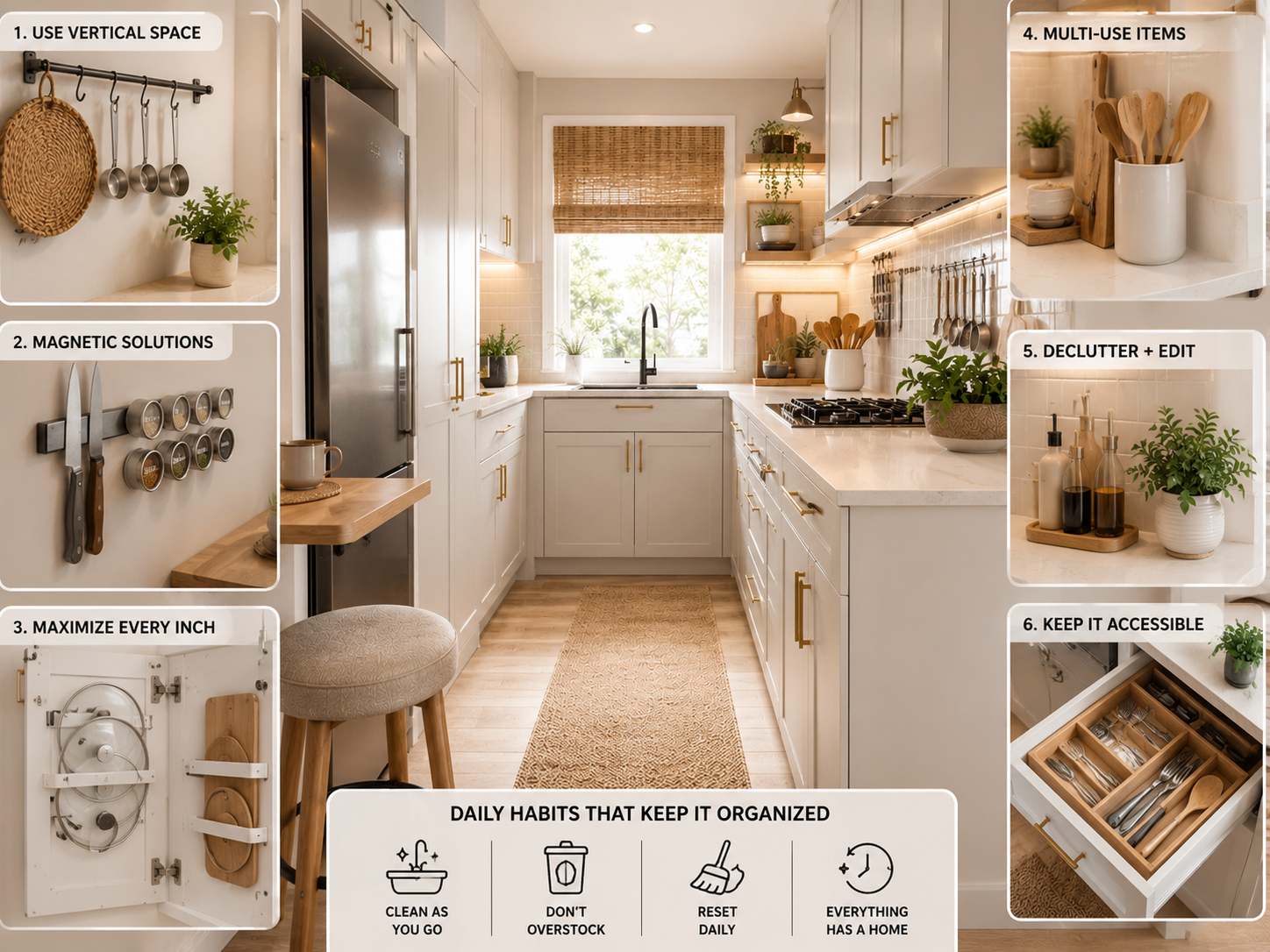
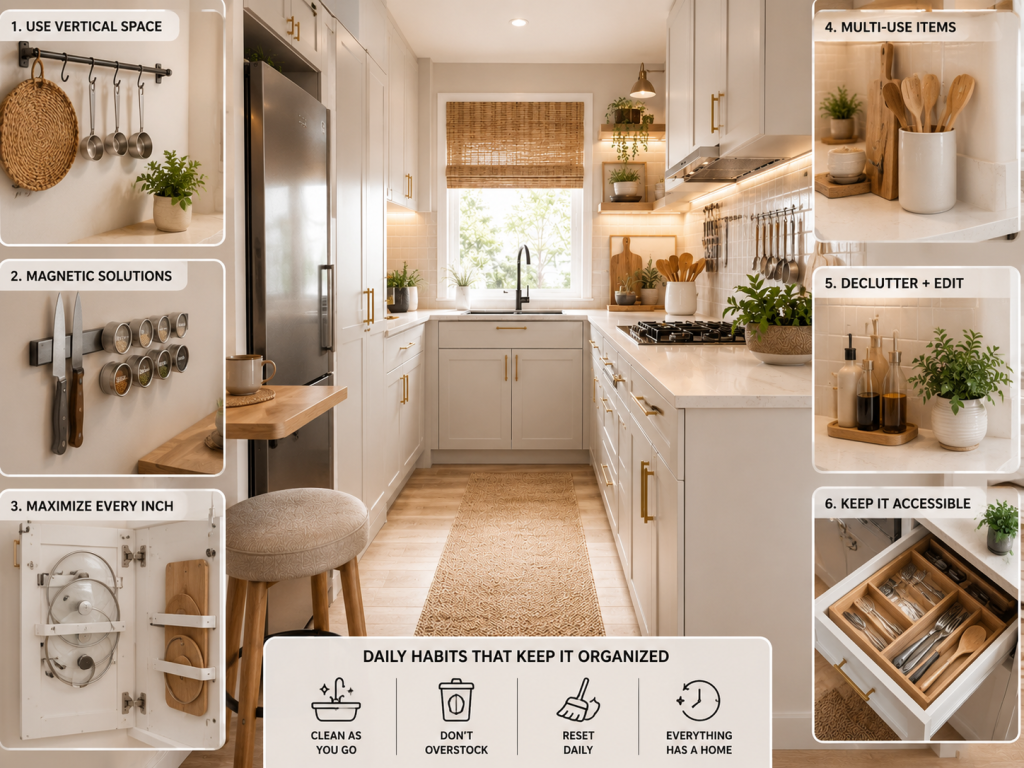
Magnetic knife strips are a perfect starting point. Mount one on the wall or even on the side of a cabinet to free up an entire drawer. They hold knives, scissors, and even metal measuring spoons safely and accessibly. Similarly, a wall-mounted spice rack above your stove or prep area reclaims precious counter and cabinet space.
Pegboards have made a major design comeback, and for good reason. A single pegboard panel installed on a kitchen wall can hold pots, pans, utensils, cutting boards, and small baskets for dry goods. You can customize the layout and rearrange it as your needs change. For a more polished look, paint it to match your wall or go with a natural wood version.
Floating shelves above the counter or between your upper cabinets and ceiling offer bonus storage that most kitchens never tap into. That space above your cabinets? It’s perfect for displaying baskets that store less-used items like holiday bakeware or extra paper goods. If you’re weighing whether open shelving makes sense for your kitchen overall, our deep dive on open shelving vs. cabinets for small kitchens covers every angle.
Common mistake: Hanging items too high to comfortably reach. Anything you use daily should be at arm’s reach. Reserve the highest spots for seasonal or occasional items.
Unlock the Hidden Storage on Your Cabinet Doors
The inside of your cabinet and pantry doors is one of the most consistently wasted surfaces in a small kitchen. A few simple, inexpensive additions here can completely change your storage game.
Over-door organizers come in wire, acrylic, or fabric, and they mount with hooks or tension rods — no drilling required if you don’t want to make holes. Inside a lower cabinet door, you can store pot lids, cleaning supplies, or aluminum foil and plastic wrap rolls. Inside an upper cabinet door, a small spice rack or a plastic wrap organizer is an absolute game-changer.
Command hooks on the inside of cabinet doors hold measuring cups, pot holders, and lightweight cutting boards. A tension rod installed inside a cabinet under the sink can hang spray bottles by their trigger nozzles, instantly freeing up the floor of that cabinet for other items.
If you have a pantry door, that’s a full wall of bonus storage. A tall over-door organizer with multiple pockets or shelves can hold spices, snacks, oils, canned goods, and more. According to Good Housekeeping’s organizing team, over-door pantry organizers consistently rank among the highest-impact kitchen storage purchases for small spaces.
Rethink Your Drawers and Cabinets With Smarter Systems
The containers and organizers inside your cabinets and drawers matter enormously. Random, mismatched containers that don’t stack efficiently can cut your usable storage capacity in half.
Stackable, clear containers are worth every penny. Switching your dry goods — flour, sugar, oats, pasta — from their bulky original packaging to uniform, stackable canisters can transform a chaotic pantry cabinet into an organized, efficient system. You can see exactly what you have at a glance, and you can stack them to double your vertical capacity inside the cabinet.
Cabinet shelf risers and inserts create a second level inside your cabinets so you’re not stacking plates precariously or burying items behind each other. A simple wire shelf riser costs just a few dollars and can effectively double the storage of any cabinet shelf.
Drawer dividers are non-negotiable for utensil drawers. Without them, your entire drawer becomes a jumbled mess that takes twice as long to search through. For your junk drawer — yes, even that needs to be organized — use small bins or ice cube trays to corral batteries, twist ties, and other miscellany.
For deeper lower cabinets, use pull-out baskets or turntables (lazy Susans) to access items in the back without emptying the front. These are especially helpful for corner cabinets, which are notorious dead zones in small kitchens. If you’re considering a broader kitchen upgrade on a budget, check out these small kitchen remodel ideas under $500 that can make a big difference without breaking the bank.
Multi-Use Furniture That Earns Its Keep
When you’ve maxed out your built-in storage, it’s time to bring in furniture that does double or triple duty. The key is choosing pieces that earn their floor space by contributing more storage than they consume.
Rolling kitchen carts are arguably the most versatile small kitchen investment you can make. A cart with shelves, drawers, and a butcher block top adds both prep space and storage in one. When you’re not using it, it tucks against a wall or into a corner. When you need it, it rolls to wherever you’re working. Look for carts with hanging bars on the sides for additional utensil hooks.
A kitchen island with storage — even a small one — can add significant cabinet and drawer space. If a fixed island is too large for your floor plan, a compact island on wheels offers the same benefit with flexibility. Understanding kitchen island costs ahead of time helps you budget realistically for this addition.
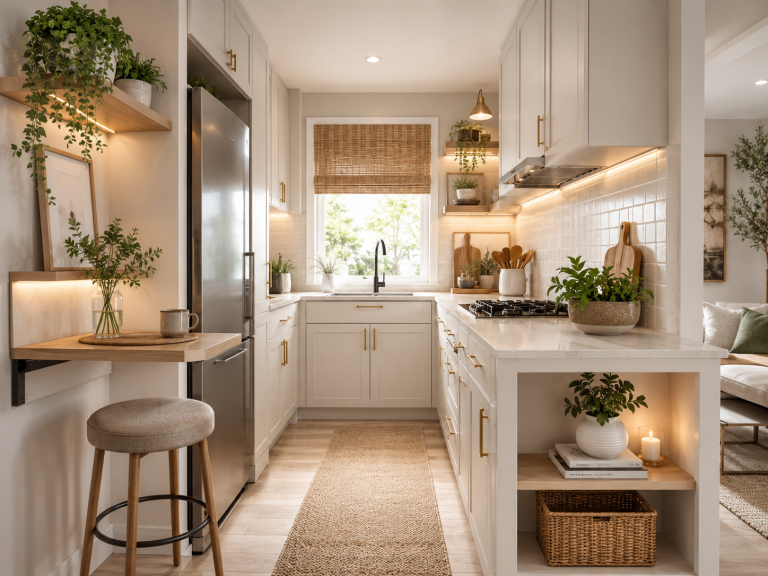
Fold-down tables mounted to the wall are a brilliant option for kitchens that double as dining areas. When folded up, they take up virtually no space; when folded down, they provide a full dining or prep surface.
Pro tip: Avoid furniture with purely decorative value in a small kitchen. Every piece should serve a functional purpose, ideally more than one.
Use the Spaces You Forgot Existed
Small kitchens have secret storage spots that most homeowners completely overlook. Training yourself to see these hidden opportunities is a skill that pays off immediately.
Above the refrigerator: This awkward space is almost always ignored, but it’s perfect for a basket or bin holding items you don’t need daily — extra paper towels, the waffle iron, or bulk pantry overflow.
The side of the refrigerator: Magnetic organizers made specifically for fridge sides can hold spice racks, paper towel holders, and even small shelves. If your fridge sits beside a wall, a slim rolling pantry cart that fits in that gap can add substantial storage with zero footprint expansion.
Under the sink: Most people treat under-sink cabinet space as a dumping ground. With a two-tier shelf riser, some door-mounted organizers, and a small bin system, it can hold cleaning supplies, dish soap, trash bags, and more in an organized and accessible way.
Inside deep drawers: Stack pots and pans inside deep drawers using drawer peg systems (sold by brands like IKEA) that hold lids upright and organize pans vertically — this is far more efficient than stacking them in a cabinet.
For even more creative inspiration, our roundup of small kitchen ideas that make tiny spaces feel huge is packed with visual inspiration and practical advice.
Maintain the System So It Lasts
Even the most thoughtfully organized small kitchen will collapse back into chaos without a maintenance habit. The good news is that maintaining an organized kitchen takes far less effort than organizing a chaotic one — you just need a few simple routines.
The reset rule: At the end of each day, spend five minutes returning everything to its designated spot. This prevents the slow creep of misplaced items that eventually turns into a full-blown mess.
Quarterly reassessment: Every three months, spend 20 minutes looking critically at what’s working and what isn’t. If you consistently find yourself pulling something out from the back and never using it, it needs to go. If a particular system isn’t working — say, the spice rack on the door keeps falling off — fix or replace it before it becomes a chronic frustration.
Label everything: Labels aren’t just for type-A personalities. In a small kitchen where everyone in the household needs to find and return items correctly, labels are the difference between a system that works and one that falls apart within a week. Use a simple label maker or even handwritten kraft paper tags for a charming, functional touch.
The Wirecutter team has extensively tested kitchen organization products and consistently finds that simple, durable, and purposefully sized containers outperform trendy but impractical options — worth keeping in mind when shopping for your system.
Frequently Asked Questions
What’s the first thing I should do when organizing a small kitchen?
The very first step is always decluttering. Before buying any organizers or hooks, remove everything from your cabinets and drawers and honestly assess what you actually use. Donating, relocating, or discarding items you don’t need is the most impactful thing you can do, and it often reveals storage space you didn’t know you had.
How do I add storage to a small kitchen without drilling holes?
There are plenty of no-drill options: tension rods under sinks for hanging bottles, over-door organizers that hang on cabinet doors, magnetic strips that adhere to walls or appliances, Command hooks for lightweight items, and freestanding shelving units or rolling carts. These solutions are also renter-friendly and easy to reconfigure as your needs change.
What are the best containers for small kitchen organization?
Stackable, clear, uniform containers are the gold standard. Look for containers with airtight lids for dry goods, and choose a single brand or size family so they stack efficiently. Square or rectangular containers use space more efficiently than round ones, as they don’t waste the corner gaps. Labeling every container helps maintain the system long-term.
Can a rolling cart really make a difference in a small kitchen?
Absolutely. A rolling kitchen cart is one of the highest-ROI purchases for a small kitchen because it adds prep surface area, storage drawers or shelves, and flexibility — all in one footprint. When not in use, it tucks away neatly. When you need extra counter space or storage access, it rolls exactly where you need it. Choose one with locking wheels for stability while in use.
Conclusion
Knowing how to organize a small kitchen isn’t about having more space — it’s about using the space you have with intention and creativity. By starting with a thorough declutter, going vertical, unlocking your door backs, upgrading your container systems, and bringing in multi-use furniture, you can genuinely transform even the most cramped kitchen into a functional, calm, and enjoyable space. The best part? Most of these changes cost very little and can be done in a single weekend.
Pick one section from this guide and tackle it today. Just one. You’ll be amazed how quickly momentum builds once you see what even one small organizational win can do for both your kitchen and your mood. Your dream of a kitchen that actually works for you — not against you — is closer than you think. Start today, and let Cozy Spruce be your guide every step of the way.